TL;DR: For healthy aging, a strong weekly routine usually prioritizes four capabilities: aerobic endurance, muscle strength, balance, and enough mobility to move comfortably. The exact dose should match health status and ability, but the program should preserve independence and function rather than chase a single fitness metric.
Healthy aging fitness is best understood as capacity for daily life: walking, carrying, rising from a chair, climbing stairs, recovering from a stumble, reaching, and continuing valued activities. Experts may differ on exercise selection, but major public-health guidance consistently emphasizes aerobic activity, muscle strengthening, and balance for older adults.
Priority 1: Aerobic Capacity You Can Use in Daily Life
The CDC guidance for adults 65 and older recommends at least 150 minutes of moderate-intensity aerobic activity per week, or an equivalent amount of vigorous activity, along with strengthening and balance work. For someone below that level, the practical priority is not immediately hitting the full target; it is increasing activity gradually from the current baseline.
Walking is accessible for many people, but cycling, swimming, dancing, and other options may be better for some joints, preferences, or environments. The best aerobic mode is one that can be performed safely and often enough to improve or maintain capacity.
Priority 2: Strength for Independence
The National Institute on Aging overview of exercise types includes muscle-strengthening activity as a key part of healthy aging. Strength helps support tasks such as carrying groceries, standing from a chair, using stairs, and maintaining mobility. Training can use machines, free weights, resistance bands, or body weight depending on experience and access.
A useful strength program covers major movement patterns and is progressively challenging without sacrificing control. For a new or deconditioned person, learning safe technique and building tolerance may matter more than the specific equipment.
Priority 3: Balance Before a Fall Makes It Urgent
Balance often receives less attention than cardio or strength until instability appears. Practice can include supported single-leg work, tandem stance, controlled step patterns, tai chi-style movements, or other exercises appropriate to the person’s ability. The exercise should be challenging enough to train balance but safe enough to avoid unnecessary fall risk.
People with a history of falls, dizziness, neurological conditions, severe weakness, or significant mobility limitations may need supervised assessment and individualized progressions rather than unsupervised balance challenges.

Priority 4: Mobility That Serves Real Tasks
Mobility work should help a person access the ranges needed for daily function and chosen exercise. That may include ankle motion for walking and stairs, hip motion for sitting and standing, shoulder motion for reaching, and comfortable spinal movement. More flexibility is not automatically better; useful, pain-free function is the goal.
How the Priorities Fit Into One Week
| Weekly element | Example role | Possible formats |
|---|---|---|
| Aerobic activity | Endurance and cardiovascular health | Brisk walking, cycling, swimming, dancing |
| Strength training | Muscle strength and functional reserve | Machines, bands, dumbbells, bodyweight |
| Balance practice | Postural control and fall-risk reduction | Supported balance drills, step work, tai chi-style practice |
| Mobility work | Comfortable movement for tasks and training | Short targeted mobility before or after activity |
| Recovery | Support adaptation and participation | Rest days, easy movement, adequate sleep and nutrition |
These categories can overlap. A circuit may combine strength and balance. Hiking can challenge aerobic fitness and stability. A group class may include mobility and strength. The goal is to cover the capacities, not force each one into a separate hour.
Progress the Weakest Link Without Neglecting the Rest
For someone who walks comfortably but struggles to rise from a low chair, strength may deserve extra attention. For someone strong in the gym but unsteady on uneven ground, balance may be the priority. NIA research summaries on strength training and aging describe how strength can support mobility and independence, but a complete healthy-aging routine still needs more than one quality.
Adherence matters as much as exercise selection. Exercise Adherence 101 can help build a routine that survives travel, low motivation, or changing energy, which is especially important when the goal is years of continued activity rather than a short challenge.
Adjust for Conditions, Medications, and Recovery Capacity
Arthritis, heart disease, diabetes, osteoporosis, joint replacements, neurological conditions, and many other health issues do not automatically rule out exercise, but they can change the safest type, intensity, and progression. Medications may also affect heart rate, blood pressure, balance, or perceived effort. When health status is complex, exercise should be coordinated with appropriate clinical advice.
Recovery may also need more deliberate planning. Making recovery a habit explains how to protect sleep, use easier days, and distinguish ordinary training fatigue from symptoms that need attention.
Do Not Wait for Fitness to Feel “Age Appropriate”
Healthy aging is not about training like a younger person or avoiding challenge because of a birthday. It is about choosing a challenge that is appropriate to current ability and progressing it safely. Many older adults can improve strength, endurance, balance, and confidence with consistent training.
Prioritize Power and Confidence Where Appropriate
Strength is essential, but everyday function also depends on producing force quickly enough to catch balance, climb a step, or rise efficiently. For some older adults, appropriately supervised faster-but-controlled movements, such as standing up with intent or using light resistance at a brisk concentric pace, may be useful. This is not an invitation to perform explosive exercises without preparation. The movement, load, and speed should match ability, joint health, balance, and coaching support.
Confidence is another practical outcome. A person who trusts their ability to stand, carry, and walk may be more willing to remain active in daily life. Training should therefore build competence as well as fitness numbers.
A practical program should also account for the environment outside the gym. Stairs at home, uneven sidewalks, carrying tasks, floor transfers, and getting in and out of a car can reveal which capacities matter most. Exercise selection can then resemble those demands without trying to copy them exactly. The aim is to build reserve so routine tasks use a smaller share of a person’s maximum ability.
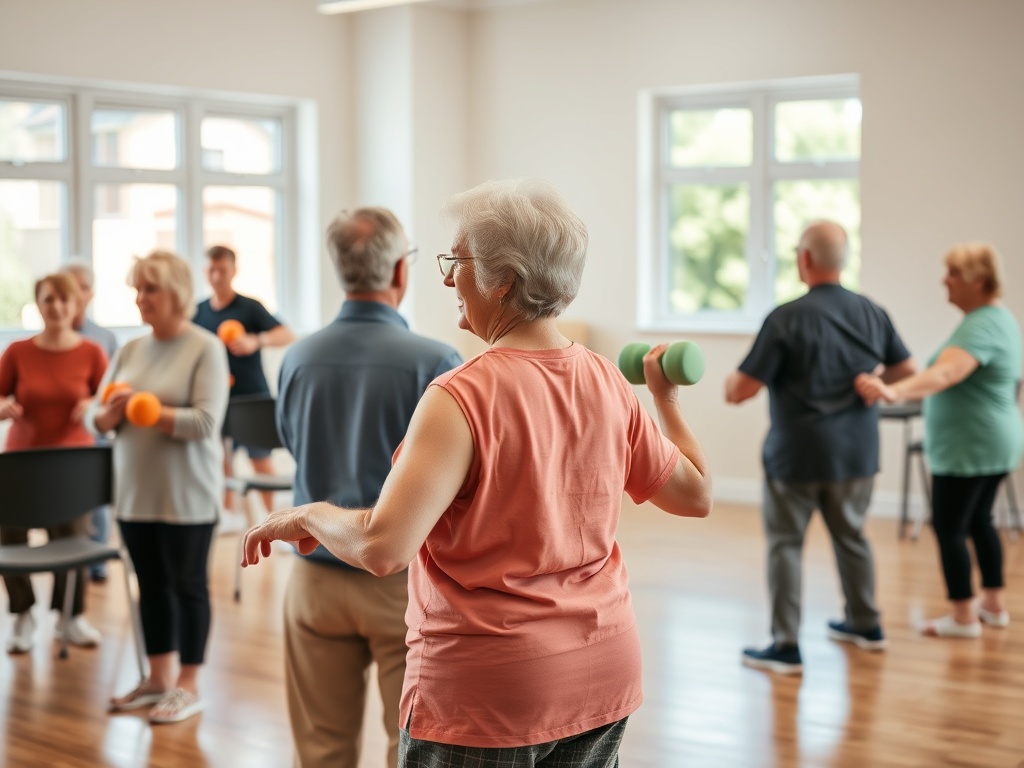
Social connection can also support healthy aging when it makes activity easier to continue. Walking groups, community classes, or training with a friend can add accountability and enjoyment. The social format is optional, not a requirement, but it can be especially useful for people who are more likely to attend an activity when it is attached to a regular appointment or shared routine.
Build the Week Around Function
A useful weekly routine asks a practical question: what capacities do you want to keep using ten years from now? Cover aerobic work, strength, balance, and mobility; give the program enough recovery; and adjust the emphasis to the person rather than to a generic age label. The best routine is one that supports independence and can continue as needs change.